
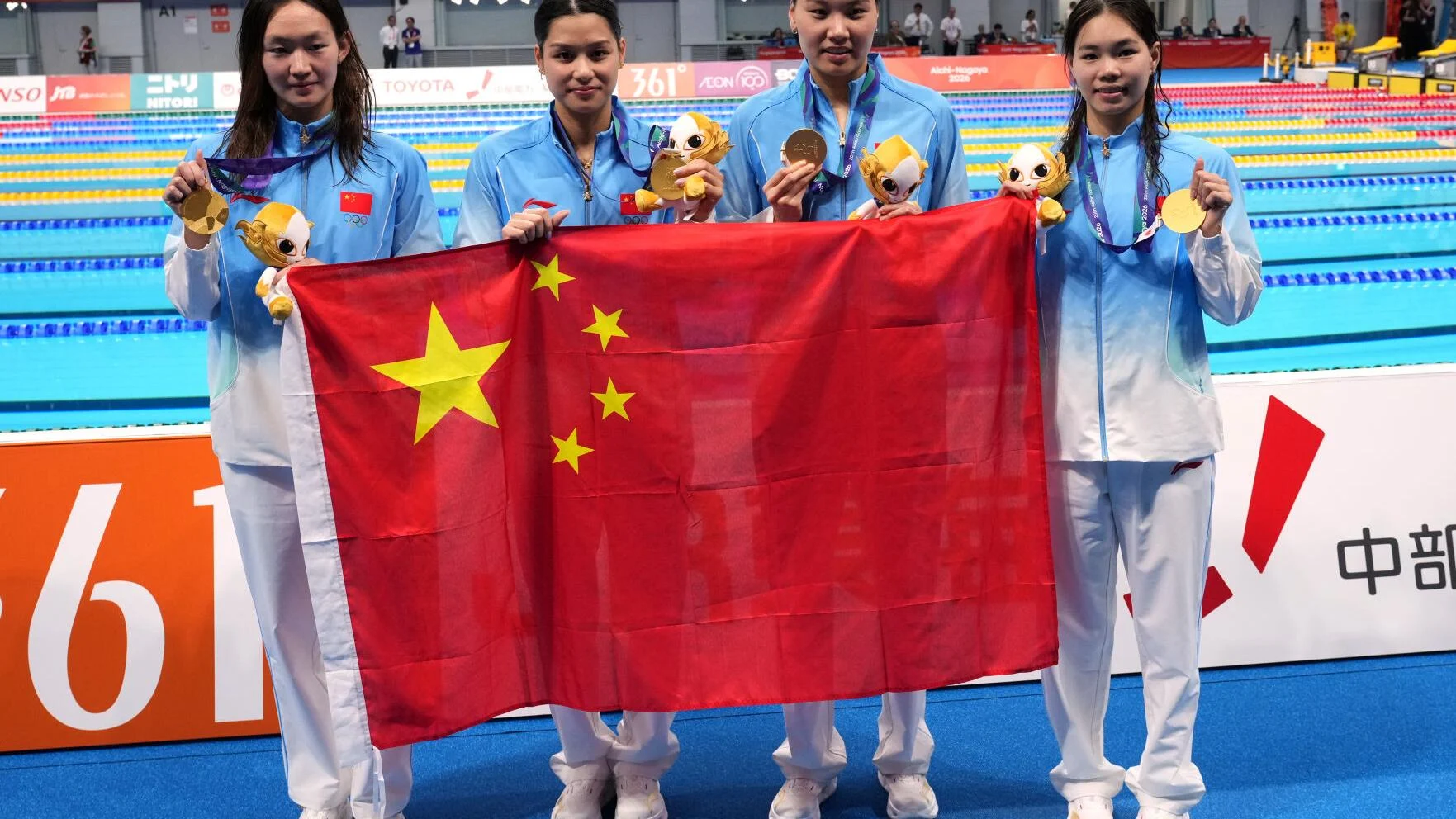
China has won 11 consecutive completed Asian Games editions. Here is how its strength in medal-rich sports and its deep athlete pool created such a large advantage.
China’s Asian Games dominance is built less on having one unbeatable generation and more on its ability to produce gold-medal contenders across a large number of events. That distinction matters because the Asian Games offer hundreds of opportunities to win, and China has repeatedly turned those opportunities into victories in sports ranging from swimming and diving to shooting and gymnastics.
Aichi-Nagoya 2026 is the latest example. The official Games period is September 19 to October 4, 2026, although some competitions were scheduled to begin before the opening ceremony, with the competition calendar starting on September 10. The opening ceremony took place on September 19, while the closing ceremony is scheduled for October 4. At this point, China had won 143 gold, 62 silver, and 51 bronze medals, 256 in total. Japan stood second with 45 gold, 71 silver, and 69 bronze, for 185 overall.
The comparison is revealing. China had 71 more medals than Japan in total, but its gold-medal advantage was much larger: 98 golds. That is because the Asian Games medal table is ordered by gold medals first, followed by silver and bronze when required. So Japan having nine more silver medals than China did not materially narrow the gap at the top. That is the clearest way to understand China’s advantage. It is not simply winning more medals. It is winning a disproportionately large share of the events that decide the standings.
Read more: At 39, Lionel Messi Leads MLS 2026 Stats
China’s Streak Began At New Delhi 1982
China hasn’t always been Asia’s leading sporting nation. Japan topped the medal table at each of the first eight Asian Games, but China changed that at New Delhi in 1982. China won 61 gold medals, four more than Japan, and finished with the same overall medal total of 153. From that edition onward, China remained at the top of every completed Asian Games.
That gives China 11 consecutive completed victories, beginning with New Delhi 1982 and ending with Hangzhou 2022, which was held in 2023 after being postponed. Aichi-Nagoya 2026 is therefore the 12th edition in which China is attempting to extend the streak, not the 12th completed victory. The historical record also shows that China’s advantage has not simply increased every four years. Its gold total has fluctuated considerably, while its position at the top has remained constant.
| Asian Games | China Gold | Runner-Up | Runner-Up Gold | Gold-Medal Lead |
|---|---|---|---|---|
| New Delhi 1982 | 61 | Japan | 57 | +4 |
| Seoul 1986 | 94 | South Korea | 93 | +1 |
| Beijing 1990 | 183 | Japan | 38 | +145 |
| Hiroshima 1994 | 125 | Japan | 64 | +61 |
| Bangkok 1998 | 129 | South Korea | 65 | +64 |
| Busan 2002 | 150 | South Korea | 96 | +54 |
| Doha 2006 | 166 | South Korea | 58 | +108 |
| Guangzhou 2010 | 199 | South Korea | 76 | +123 |
| Incheon 2014 | 151 | South Korea | 79 | +72 |
| Jakarta-Palembang 2018 | 132 | Japan | 75 | +57 |
| Hangzhou 2022* | 201 | Japan | 52 | +149 |
The Hangzhou Games were held in 2023 after the 2022 edition was postponed. China has won all 11 completed editions since 1982. The table puts China’s run into perspective. The country did not need to set a new medal record at every game to remain first. Even when its gold count dropped, it generally maintained a sizeable lead over the nearest challenger.
Also read: “I Have Lost My Peace”: Vozinha, The Cape Verdean Star
The Advantage Comes From Medal-Rich Sports
The most important part of the equation is where China wins. The Asian Games are not built around a small collection of events. A single sport can contain dozens of medal opportunities, allowing countries with significant depth in that discipline to build a large haul quickly. Swimming illustrates the point. At Aichi-Nagoya, Chinese swimmers won 30 of the 41 available gold medals. Zhang Zhanshuo won seven golds by himself, becoming the first swimmer to claim seven at a single Asian Games. That means one Chinese strength can influence the overall medal table far beyond a single headline event.
Shooting, diving, and other individual sports provide similar opportunities because medals are awarded across numerous categories. China has traditionally been particularly strong in these disciplines, creating a steady stream of gold-medal chances rather than forcing the country to depend on success in a handful of team competitions.
This also explains why China’s overall lead can become so large without the country winning every major event. At the September 30 cutoff, China had 256 medals compared with Japan’s 185, a difference of 71. Yet the gold-medal difference was 98. That tells us something specific about the competition: China’s medal production has been heavily weighted toward first-place finishes.
Its athlete pool helps sustain that output. China entered Aichi-Nagoya with 815 athletes across 38 sports and 369 events, and a large proportion of the delegation were Asian Games debutants. That matters because the system does not have to rely on a small group of established champions. New athletes can enter the programme while others leave it, keeping the country’s presence spread across a wide range of events.
China Can Lose Events And Still Lead
The 2026 Games have produced several reminders that Chinese dominance does not mean China wins everything. Japan defeated China in the men’s team table tennis final, while China failed to win a men’s singles badminton medal at the Asian Games for the first time in 52 years. India also defeated China in the women’s compound archery team final on September 30.
Those results are significant within their individual sports, but the overall medal table works differently. A setback in one event does not carry the same weight when a country has athletes competing for gold across dozens of others. That is why China’s record has proved so difficult to disrupt since 1982. Its advantage is not perfection. It is the combination of large-scale participation, strength in sports with many medal events, and a pipeline capable of continually supplying elite athletes.
As of the September 30 cutoff, China was still chasing a 12th consecutive Asian Games title rather than having completed it. The Games continue through October 4, so the final 2026 medal table will be different. But the numbers available on September 30 already show why China has remained at the top for more than four decades. The question is not whether China can be beaten in individual events. It clearly can. The bigger challenge for its rivals is producing enough winners across enough disciplines to close the gap that China creates.
Explore: Elena Rybakina Honoured With The Barys