
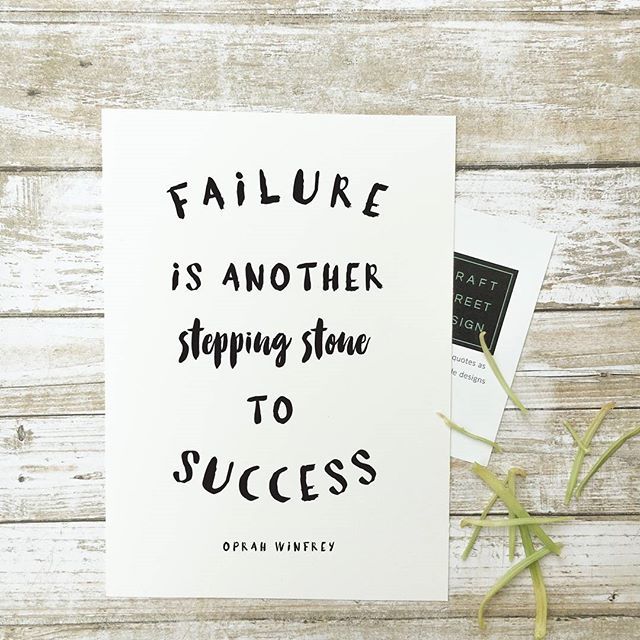
‘ Failures are stepping stones to success ‘ is one of the most cliched statements used by motivators to inspire people to keep going in pursuit of that elusive Success. I am sure we all have heard this and read about in our lifetimes. However this statement has kept me thinking over the years and I wish to present a slightly different perspective to it in my post today. There are three relevant points in my opinion which need to be looked into.
1. Failure and Success are highly Relative Terms
A cobbler sitting on the roadside had a good day. He goes home happy, has a hearty meal with his family and goes to bed in a happy frame of mind after a successful day at his little office, looking positive for the next day. At the same time a CEO of a large company fighting strong competition is upset with falling sales, profits and market share. The news is not good. The CEO is miserable and has made life of his subordinates difficult too. He takes pills even to get a fragile sleep. Inspite of his lavish office and so much at his beck and call, the CEO is anxious of his company’s failings.
The cobbler and the CEO are on the extreme sides of our social spectrum. If compared the Cobbler would be relatively less successful than the CEO, however in their own world the Cobbler has tasted success while the CEO has a fight on his hands to avert failure.
It is imperative, therefore to understand that failure and success are not generic terms and cannot be applied uniformly. It all depends on one’s circumstances, interests, goals, targets and eventually the all encompassing ambition and in some cases it’s just the pursuit of happiness. So as individuals and even as organisations let us not compare our failures and success with the incomparable.
2. Failure and Success are nothing but mere Experiences
In pursuit of success we traverse various stretches and paths resulting in several experiences. They may be good and bad too. It is not necessary to have a bad experience ( or a failure as they say ) to reach the ultimate goal u are chasing and it is also not necessary that good experiences ( small victories) along the way will guarantee the achievement of the ultimate goal.
Therefore failures are not mandatory to reach success. It is not necessary to fail to be successful. Can a worker fixing screws in an assembly line afford to fail often. He cannot . Yes there can be an odd mishap like a malfunction of a tool or the shearing of the screw, but only as an exception. However, The worker may always work on his experience and try and improve his performance by being more efficient and therefore enhancing the productivity of the assembly line. He can use both his odd failure and regular success to build something much better.
Critical is the learning we imbibe from our good and bad experiences and how we apply them is the truth of the matter.
3. Analysing Experiences : Never play the blame game
Both good and bad experiences need to be properly analysed. The bad ones with some more concern and focus, because the answers are never easy to get and a wrong judgement and blame game may have far reaching consequences. Taking the similar example of the worker fixing screws, it was found that the screw was getting sheared time and gain. The assembly line manager was immediately flagged off the issue, who confronted the worker. The manager reprimanded him and told him to be careful while doing his job. The blame was put at the worker’s door. However when the problem persisted a deeper analysis had to be done which revealed the problem. The metallic composition of the screws was not upto the mark resulting in its shearing. The problem was immediately conveyed to the supplier who rectified the issue and the problem was resolved.
The learning from the bad experience of the screw shearing away was spot on due to a thorough analysis of the problem and not merely reprimanding the not at fault worker. it happens several times both as individuals and organisations that bad experiences lead to blames games rather than a much deeper examination to get to the root of the problem, which could be detrimental for success.
There is no need to count your failures and success. It is important to count your experiences. It is important to examine how are you evolving from these experiences and whether they are leading you to the ultimate goal of your life.
Keep working, learning, evolving and improving in a consistent manner are in reality your stepping stones to success.
Most of us have heard the Scottish legendary story of the deposed King Robert Bruce who while being in exile was inspired by a Spider’s repeated attempts in harsh windy conditions to build its web. It ultimately succeeded weaving a thinner string to reach out the distance, complete the web and succeed at last. Bruce learnt his lesson from here. On seeing the Spider succeed after several failures Bruce resolved after his five failed attempts to make another try and recover his kingdom. And this time he succeeded and won the battle with a new strategy that traumatised his opponents with awe and fear.
Riz Khan has very aptly demonstrated in this Post that the ingredients for ‘Success’ besides ‘Failure’ are many others also such as learning, evolving, working, learning and differently strategising/ innovating etc.
A very thought-provoking Post from Riz Khan which would certainly earn its due approbation from all researchers in management studies.
Excellent background given and beautiful written